.svg "NuWave_A_Centaris_Company")

Michigan manufacturers and professional services firms managing I.T. across multiple vendors face a version of this every time something goes wrong:
Imagine you bought the best security system, smoke detector, and water sensor. Each one works perfectly on its own.
But you hired three different monitoring companies. They don't talk to each other and none of them sees the whole picture.
When something goes wrong at 2 a.m., you get three phone calls. By the time anyone connects the dots, the damage is done.
That is how many mid-market I.T. setups look right now. Capable tools. Capable partners. No one watching the whole picture.
When something goes wrong, that gap is where the damage lives.
The Stack Is Half the Story
Tools only prevent problems they can see.
A strong technology stack matters. Endpoint protection, cloud, backup, threat detection, A.I. monitoring - these are the capabilities that prevent real problems before they hit production.
But when your stack is split across providers who each watch their own slice, no one is watching the whole picture.
The other half of the story is accountability.
One I.T. partner who owns the integration. A partner who sees how cybersecurity, cloud, identity, and A.I. predictions all connect. Not three providers pointing at each other.
Without that ownership layer, even a strong stack leaves gaps.
Why This Matters More Now
Five years ago, this was inconvenient. Today, it is a prevention problem.
Modern attacks do not announce themselves. They show up as a login from one country at 2 p.m. and a different country at 2:15 p.m., as a Copilot query that pulls a document the user never should have had access to, as a small change in how a service account behaves at 3 a.m. on a Sunday. These are not the threats your firewall was built to catch. They are pattern-recognition problems, which is why A.I.-driven monitoring has become the baseline for prevention.
But only if the A.I. can see the full pattern.
Your endpoint A.I. sees endpoints. Your cloud A.I. sees cloud. Your identity A.I. sees logins. None of them see each other. The connections that matter most live in the spaces between them.
That is where attackers operate.
For a Michigan manufacturer running production around the clock, that gap is where a six-figure ransomware bill starts.
For a professional services firm holding client data, it is where a regulatory disclosure starts.
The connected environment is what determines whether A.I. prevention actually prevents anything.
What "One I.T. Partner" Actually Means
One I.T. partner means one accountable provider running your environment as one connected system. Someone who sees how cybersecurity, cloud, identity, and A.I. monitoring all fit together, and owns the picture when something needs attention.
For businesses with internal I.T. teams, this looks like co-managed I.T. services.
Co-managed I.T. means the provider operates alongside your existing internal team — handling tools, monitoring, and the security layer while your team focuses on day-to-day operations and the relationships they support. Your stack stays. Your team stays. What changes is who owns the picture.
The provider layer adds enterprise-grade tools, A.I. monitoring, and the cross-stack visibility most internal teams cannot maintain alone. Co-managed I.T. services are about augmentation, not replacement.
For businesses without internal I.T., this looks like full outsourcing. One provider builds, runs, and protects the whole environment. Same accountability model, different starting point. Your business focuses on what your business does. We focus on the I.T. that supports it.
What to Look For in Managed I.T. Services in Michigan
The question to ask is not whether a provider claims single accountability. Many do. The question is whether they can show you what single accountability looks like in practice.
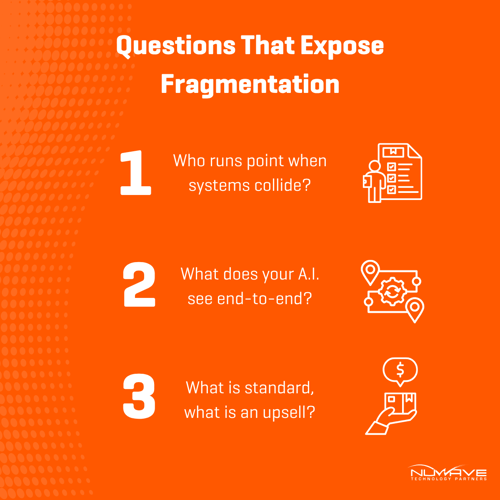
Three questions get to the answer fast:
- When something goes wrong across multiple systems, who runs point?
Ask your provider to walk you through what happens when a Microsoft 365 issue, a network issue, and an endpoint alert all hit at the same time. If the answer involves you coordinating between vendors, that is not single accountability. That is you doing the integration work. - What does your A.I. see across the whole environment?
Ask them to show you. Not a brochure, an actual view of how their monitoring connects identity signals, endpoint signals, and cloud signals into one picture. If they can only show you one piece at a time, that is what their A.I. can only see at a time. - What is included as standard, and what is an upsell?
Get the line items. Cybersecurity, dark web monitoring, penetration testing, A.I. monitoring, 24/7 SOC, M365 oversight, these should be in the agreement, not added on. If they are upsells, your business is running optional security.
The Bottom Line
Complete prevention needs two things working together. A capable technology stack, and a single I.T. partner accountable for running it as one connected system. Either one alone leaves something on the table.
When both are in place, I.T. stops feeling like a coordination problem. It starts feeling like infrastructure that quietly does its job.
If you would like to see how those questions land in your environment, we can walk through them together — no pressure.
That is what simpler managed I.T. services in Michigan actually look like. Not fewer tools. One picture.
Frequently Asked Questions
What does a managed I.T. provider do for a Michigan manufacturer? A managed I.T. provider handles the technology infrastructure a manufacturer depends on — endpoint security, cloud environments, identity management, and network monitoring — as a single accountable partner rather than multiple vendors. The goal is prevention: stopping problems before they reach the production floor.
What is the difference between co-managed and fully outsourced I.T.? Co-managed I.T. means your internal team stays in place. The provider adds monitoring tools, security layers, and strategic oversight that most internal teams cannot maintain alone. Full outsourcing means the provider runs the entire environment. Both models operate under a single-partner accountability structure.
How does A.I. monitoring work in a manufacturing environment? A.I. monitoring watches for behavioral anomalies across your systems — a login from an unusual location, a service account accessing files outside its normal pattern, an endpoint behaving differently than it has historically. It catches the signals that precede incidents, not just the incidents themselves. The value depends on whether the A.I. can see across your full environment or only one layer at a time.
What should be included in a managed I.T. services agreement in Michigan? Cybersecurity, dark web monitoring, A.I.-driven threat detection, 24/7 SOC coverage, and Microsoft 365 oversight should be line items in the agreement — not upsells. If core security services are optional add-ons, the base agreement leaves gaps your environment cannot afford.

.png?width=366&height=225&name=Untitled%20design%20(6).png)