.svg "NuWave_A_Centaris_Company")

You've been at your desk for forty minutes and you've already read four articles about A.I.
Not because you went looking. Because they came to you — fed into your LinkedIn, forwarded to your inbox, attached to vendor emails you didn't ask for. A debate about which model is winning. A think piece on the end of the traditional IT role. A press release from a competitor announcing their AI-powered infrastructure monitoring—with a quote from their CTO about how their team now does more with less.
You close the tab.
Because while everyone seems to have strong feelings about AI, yours are harder to name. There's the economic worry—what it means for your business if you're moving slower than everyone else. There's the quieter concern about your people—what automation actually means for the team you've built. And underneath both of those, something closer to exhaustion: it's moving fast enough that every time you try to form a clear opinion, something new has already changed it.
For now, it seems like the easiest thing to do is stay silent. But that's ignoring the dangers of quiet prompting.
What is Quiet Prompting?
Your team is interacting with A.I., whether you address it or not.
Sure, some of them discuss it openly—the systems admin who shows off something he "vibe coded" on the weekend like a proud father. But most are more subtle.
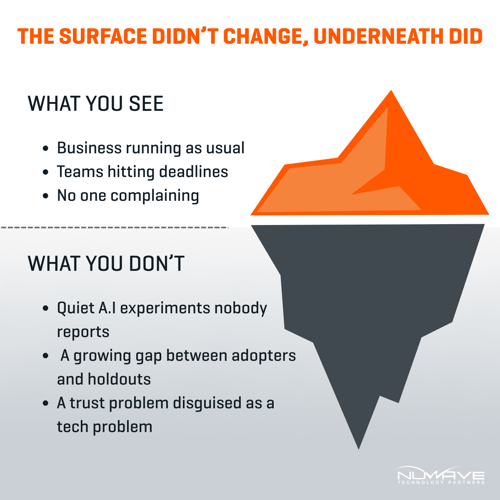
Your best problem solver figured out she can automate two hours of her morning — three months ago. She hasn't told anyone. Not because she's hiding something, but because she's doing the math on what happens when leadership realizes half her workload runs itself.
And she's not the only one. A few others are quietly experimenting.
- Drafting emails faster.
- Pulling reports in minutes instead of hours.
- Getting more done and saying less about how.
And the people who aren't using AI? They're watching. They see colleagues moving faster and they don't know why. Some dig in harder on the old way. Some start to quietly resent the people who seem to have figured something out.
Nobody's talking about any of it.
There's a split forming inside your team that you didn't create and probably can't see—people quietly using A.I. on one side, people hardening against it on the other. The growing gap between them has nothing to do with technology and everything to do with trust.
That's quiet prompting. Not one person hiding something from leadership. An entire team navigating an unspoken set of rules because no one has said out loud what the rules actually are.
What quiet prompting is costing you
The problem isn't that your team is using AI. The problem is that you don't know how.
When there's no shared framework or IT governance structure, you lose visibility into what's actually happening. Your best problem solver is running her work through a tool you haven't vetted. You don't know what data she's feeding into it, what platform she's using, or whether it meets your compliance requirements. She doesn't either — because no one told her what the standard was.
That's not a people problem. That's a leadership gap.
And it compounds. When A.I. use is invisible, so are the mistakes. A hallucinated output that makes it into a report. A third-party tool storing sensitive data somewhere it shouldn't be. A process that now depends on a free API account one person set up on their own. None of it surfaces until something goes wrong.
Meanwhile, the split on your team is widening. The people using A.I. are pulling ahead. The people who aren't are falling behind and starting to feel it. The resentment is quiet now. It won't stay that way.
You're also missing something harder to quantify: the strategic upside. Your competitors are making decisions about where AI fits in their operations and how to integrate it into their IT infrastructure. You're not—not because you don't care, but because the conversation hasn't happened. While you're waiting for enough clarity to say something, the window for shaping how this goes is getting smaller.
The silence was never neutral. It just felt that way.
So What Can you do about it?
The companies that are moving forward didn't start with a technology decision. They started with a conversation.
A real one. Out loud.
They asked their teams:
- Where are you stuck?
- Where are you already experimenting?
- What's working? What's not?
When you make it safe to answer those questions honestly, the silence breaks. The tools people were using quietly came into the open. The ones who were digging in against A.I. stop guessing what it means for them. The ones who were hiding how much they'd figured out stop worrying they automated themselves out of a job.
Busywork starts falling away and your people stop spending their talent on tasks that don't need them. The team you already built starts reaching a level that wasn't possible before.
That's when A.I. workforce transformation stops being a threat and starts being something you can actually lead.
Not because you bought the right platform. Because you opened the right conversation.
The Quiet Part Out Loud
You've steered your company through market shifts and economic storms. This one is moving fast, but you've never been the type to flinch.
The leaders pulling ahead right now aren't the ones with the biggest A.I. budget. They're the ones who made it safe for their team to talk about what's already happening.
That's the door. Not a tool. A conversation.
And you don't have to have it alone.
NuWave has guided manufacturing teams through exactly this — helping them move from quiet prompting to intentional AI strategy without creating risk or disruption. We understand the manufacturing IT environment, the compliance implications, the real operational constraints. With NuWave beside you, you have a partner that can help you lead those conversations and bring your business, and all the parts you love about it, with you into the future.
The technology is already in the room. Let's talk about what's in yours.
READY TO MOVE FROM SILENCE TO STRATEGY?
Develop Your AI Strategy in 30 Days
Learn how to move your IT infrastructure from quiet prompting to intentional, governed AI use. Build a framework that helps your manufacturing team work smarter without creating compliance risk or visibility gaps.