.svg "NuWave_A_Centaris_Company")

OPERATIONAL RESILIENCE THROUGH AI PREVENTS OPERATIONAL FAILURES
Your server crashes at 2 AM, and your IT team responds fast. But here's the problem: if they're...
The last decade sold you one promise: automate everything.
Remove people from decisions. Optimize for pure efficiency. Build factories that run themselves.
Some companies went all-in on that vision, while others hesitated. Then disruptions hit.
For the past decade, Industry 4.0 pushed maximum automation. The pitch was everywhere: Remove humans from decisions. Optimize for pure efficiency. Build factories that run themselves.
Companies went all-in on IoT, AI, and robotics based on this vision. But then workers quit, and systems failed in ways nobody predicted.
A pattern became clear: The most automated lines were the most fragile. When they failed, teams couldn't adapt.
But the operations where people stayed in the loop? They bent without breaking.
A framework called Industry 5.0 is spreading through manufacturing circles. It's not about new technology, it's about a different question.
That shift changes everything.
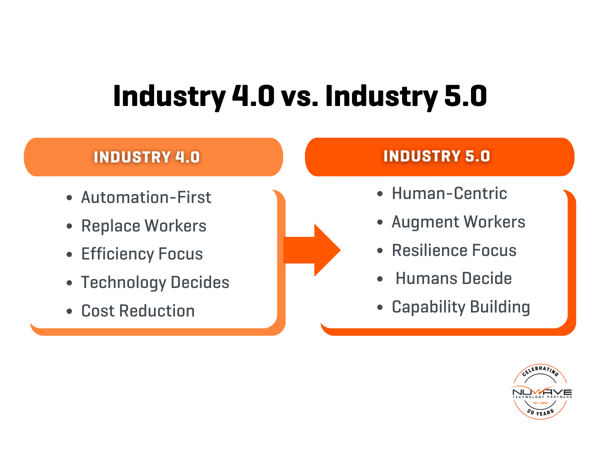
Human-centric design. Technology helps workers instead of replacing them.
Resilience. Systems adapt when disruptions occur because humans stay in the loop to think, adjust, and respond to what algorithms can't predict.
Sustainability. Building capabilities that last instead of chasing short-term efficiency gains that make operations fragile.
The interesting part? This doesn't require new technology. It requires using existing tools with different intent.
AI monitoring catches system problems before they become failures.
An IT director gets early alerts with analysis. They check it against business priorities, upcoming maintenance windows, critical business cycles, and team availability. Then they decide the response based on context the AI doesn't have.
The technology didn't bypass the person. It equipped them with information they couldn't gather alone.
This co-managed approach builds on what works: experienced people who know the business, now supported by advanced monitoring tools and specialized expertise.
The technology serves the team's decisions, not the other way around.
The skills gap makes augmentation necessary.
Companies can't find qualified workers, and neither can their competitors. The answer isn't eliminating people, it's making current people more capable through better tools and support.
Heavy automation creates dependency when systems work but leaves operations vulnerable when they don't.
Augmentation builds resilience when disruptions hit.
Pure efficiency works in stable conditions. But conditions rarely stay stable.
Operations need people who can think and adapt because algorithms can't handle every situation. The competitive advantage isn't automation. It's adaptable people with powerful tools.
This difference between replacement and enhancement plays out everywhere, including in IT services.
Many MSPs came in with the full outsourcing pitch: replace IT teams, reduce headcount, automate everything.
But manufacturing leaders saw the same problem.
Lose the person who knows the operation inside and out? That's losing something irreplaceable.
Hand over complete control? That creates a different kind of risk.
Some manufacturers looked for a different approach—partners who would augment rather than replace.
Over time, a clear difference emerged:
Heavy automation made systems fragile and full outsourcing created dependency.
But operations that enhanced their teams? They built resilience.
Before your next technology investment, ask:
The competitive advantage isn't automation. It's adaptability. And that comes from capable people with powerful tools.
That's what Industry 5.0 describes.
Industry 5.0 isn't just a manufacturing framework; it's a lens for every technology partnership decision.
The question isn't just "Can they manage our systems?" It's "Will they strengthen my team's capabilities or replace them?"
Want to discuss what this means for your operation? We've worked with Michigan manufacturers navigating these decisions for 20+ years.
Let's talk about where you are and what you're building. Contact NuWave today!
Your server crashes at 2 AM, and your IT team responds fast. But here's the problem: if they're...