.svg "NuWave_A_Centaris_Company")
AI in Practice: How to Adopt AI Without the Data Security Risks

Small to mid-market companies feel that pressure the most. It sounds like the only options are building AI-driven security yourself, or paying for a specialist you cannot afford.
It comes down to two things. Most of what you're paying for gives you assumed coverage. You believe it's handled because the tool exists. Active coverage is different: it's configured correctly, and somebody is watching what it flags.
But you don't have to spend a dollar or lose another month deciding. The AI threat detection you think you need to build from scratch is probably already built into what you are paying for. Responding fast is good. Catching it before it becomes a problem is better.
The pressure to adopt AI sounds the same no matter where it comes from, adopt it or watch competitors pull ahead.
If your company has an in-house IT team, the worry is technical. AI could disrupt the network on its own, or flood the team with errors to chase down. The engineers on staff were never trained to build AI systems, so auditing, securing, and maintaining one is not an area they are experts in.
If you outsource your IT, the worry is different. An automated system is doing work a person used to do. You want to know whether a silent failure or a gap between vendors would actually get caught.
Either way, the assumption is the same: hire specialized talent to handle it.
That talent is not cheap. Data scientists and machine learning engineers who can build and train models regularly earn more than $150,000 a year. For a company with 60 or 100 employees, that is not a routine hire. It is a major financial commitment many owners would struggle to defend at budget time.
Faced with a $150,000 price tag, owners do one of two things.
Some freeze, filing AI under someday while the pressure waits.
Some buy a separate AI-powered security tool dressed up as progress that mostly duplicates the automated threat detection decent monitoring should already include.
Either path costs something.
Waiting means a real attacker could already be inside while competitors keep moving. Buying leads to paying twice, once for the new tool, and again later for the monitoring.
You probably overlook one thing about AI threat detection: the model that spots unusual patterns in the first place is already built.
It runs inside the platforms you are already paying for:
Microsoft 365
Your endpoint protection
Whatever security tools came bundled into your I.T. agreement
Most attacks today skip traditional malware entirely. Last year 82% of detections were malware-free. That's why Microsoft Defender and other major platforms run on behavioral detection by default.
The piece that still needs a person is smaller than many people assume, and it's the difference between assumed coverage and active coverage.
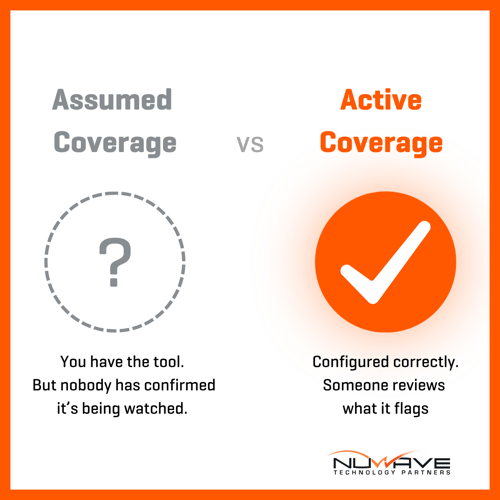
This is what active coverage looks like: a workstation flags unusual activity at 3 a.m., the system isolates it, and a security analyst confirms what happened before anyone on the client's team has logged in for the day. It's the bar we hold ourselves to.
That confirmation step is the whole point. According to Microsoft, 46% of all security alerts are false positives, and software alone cannot tell you which ones are real.
Both paths cost you. Techaisle puts the average security incident for a small to mid-market company at $1.6 million.
Asking your IT team one direct question costs you nothing and gets you a real answer either way: is AI threat detection already active and configured correctly in what you pay for, and who is reviewing what it flags?
If the capability is already active and someone is watching it, you can stop worrying about falling behind. If it’s not, you now know exactly what to fix instead of guessing at a bigger problem.
The same test applies to catching problems anywhere in your stack. The only way to know is to ask.