.svg "NuWave_A_Centaris_Company")
5 Common Business Technology Problems & How to Fix Them
With very few exceptions, modern businesses simply cannot function independent of the internet and...
A server does not fail all at once, and neither does a switch, a backup job, or a hard drive. The outage that stops your line on a Tuesday morning usually started days earlier, as a small signal nobody noticed. By the time you see it, it's a problem that has already cost you time and money.
The gap between when a problem starts and when someone notices is where predictive monitoring does its work. Many I.T. teams are built to react. When something breaks, an alert fires, and someone scrambles.
Predictive monitoring flips the order. It catches the problem before it becomes a crisis that brings your production to a grinding halt.
When I.T. problems get expensive, the instinct is to respond faster. Quicker tickets, shorter response times, more people on call. But a faster response is still a response. The damage is already in motion by the time anyone picks up the phone.
The real win is when your I.T. can prevent the downtime from happening at all.
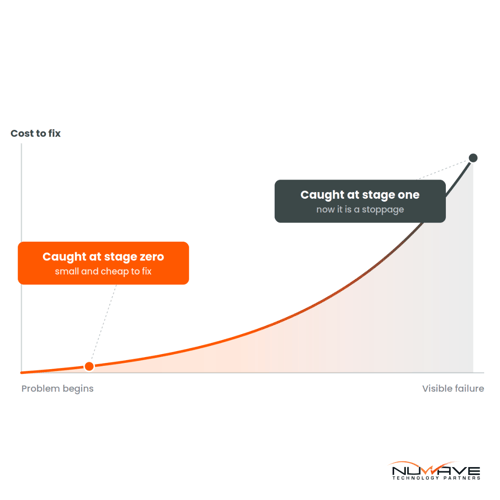
Think of an I.T. problem in stages. Stage one is the visible failure, and it's what you normally judge your I.T. department on. The line is down, the order is late, and the customer is calling. Now the team jumps into action.
But there is an earlier stage: stage zero. Before any failure, there are signs that can be read. When you read them correctly, they signal a failure is in the works. These signs can be:
A drive showing the first signs of wear
Memory creeping toward its limit
A backup that quietly stopped completing
A switch showing intermittent packet loss
A server behaving differently than its normal baseline
At stage zero, the fix is small, cheap, and invisible to your customers. At stage one, it is a production stoppage.
That difference matters because downtime is brutal. According to a 2024 report from Siemans, small and mid-sized manufacturers can lose up to $150,000 for a single hour of unplanned downtime. The earlier you catch the cause, the less of that bill you ever see.
Most operations already have monitoring, so the honest question is not whether you have it but what kind.
Traditional monitoring waits for a threshold to trip: a disk hits 90 percent full, a server goes offline, an alert goes out. That alert is useful, but it fires at stage one, after the failure is already in motion. It tells you the line is down. It cannot tell you the line is about to go down.
Predictive monitoring works earlier. It uses AI to learn how your systems normally behave across thousands of devices, then flags the small deviations that tend to come before a failure. Maybe it's a drive writing a little slower this week, or a pattern that matched the last three outages. The AI sees the discrepancy and acts on it while the problem is still small. That is the layer that operates at stage zero, before the alert and before the scramble.
For you, that looks like fewer surprises. Problems get handled during a quiet maintenance window instead of in the middle of a shift. Your organization stops losing mornings to emergencies it never saw coming.
This is not a reason to replace the people who keep your operation running. It is a reason to give them better sight. The right partner adds predictive monitoring on top of your existing team, not in place of it.
If you want to know whether your current monitoring is reactive or predictive, ask these questions:
Are we identifying problems before they affect production, or only after an alert fires?
What systems are being monitored: endpoints, servers, backups, switches, firewalls, and cloud services?
Do you track normal behavior over time, or only fixed thresholds?
How are early warning signs reviewed, prioritized, and acted on?
Can you show examples of issues caught before they caused downtime?
What reports will we see, and how often will we review them?
A good provider should be able to answer those questions clearly. They should also be able to explain what they monitor, what they have learned from similar environments, and how their process helps your internal team instead of replacing it.
NuWave monitors 4,000+ endpoints across Michigan and has provided managed I.T. services for more than 20 years. Predictive monitoring is one of the capabilities NuWave layers onto teams that are already doing good work, especially when an organization wants better visibility without replacing its existing I.T. staff.
If you are not sure whether your current I.T. approach is catching problems at stage zero or responding at stage one, that is the conversation worth having.
See how co-managed monitoring fits alongside an existing I.T. team.